 |
|
 |
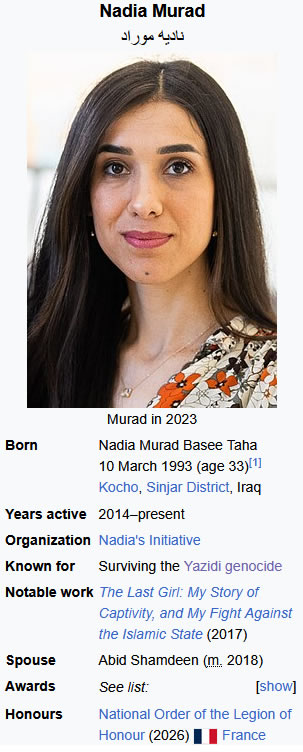 |
Nadia Murad: It shouldn't have been open. For three months, every door had been locked, every window barred, every attempt at freedom met with violence so severe it left her unable to walk. But on this November night, someone made a mistake and Nadia Murad ran. She was 21 years old. Three months earlier, ISIS had stormed her village of Kocho, executed her six brothers and her mother, and loaded the younger women onto buses like cargo. What they called sabaya. What the rest of the world calls sex slaves. Nadia had been sold seven times in those three months: passed between ISIS fighters like property, raped repeatedly, beaten, burned with cigarettes. When she tried to escape once before, six men gang-raped her as punishment and beat her so badly she couldn't stand. But now the door was open. A neighboring Muslim family risked execution to hide her. Underground networks smuggled her to a refugee camp. Eventually, Germany granted her asylum. She was safe - she was alive. Most survivors choose silence. In communities where honor culture can destroy a rape victim's future, speaking up means risking everything. Most women who escape what Nadia escaped spend their lives trying to forget. Nadia walked into the UN Security Council chamber in December 2015 and refused to use euphemisms. She was 22, speaking in her second language to a room of diplomats and world leaders. She didn't say "mistreatment", She said "rape". She didn't say "taken", she said "sold". She described being bought and sold like cattle. She talked about nine-year-old girls being raped, about mass graves, about friends who died. She spoke for 20 minutes. When she finished, the chamber was silent. Then she made her demands: recognize this as genocide, prosecute ISIS, don't let the world forget the Yazidis. In 2016, the UN declared it genocide. In 2018, at 25 years old, Nadia won the Nobel Peace Prize. She used her acceptance speech not to celebrate, but to remind the world that 3,000 Yazidi women and children were still missing. She could have taken the prize and disappeared into private life. Instead, she founded an organization rebuilding destroyed Yazidi communities. She continues testifying, traveling, reliving her trauma in front of cameras and courtrooms because thousands of Yazidis are still missing and justice remains incomplete. Her legacy isn't survival. It's the refusal to let survival be enough. |