 |
 |
 |
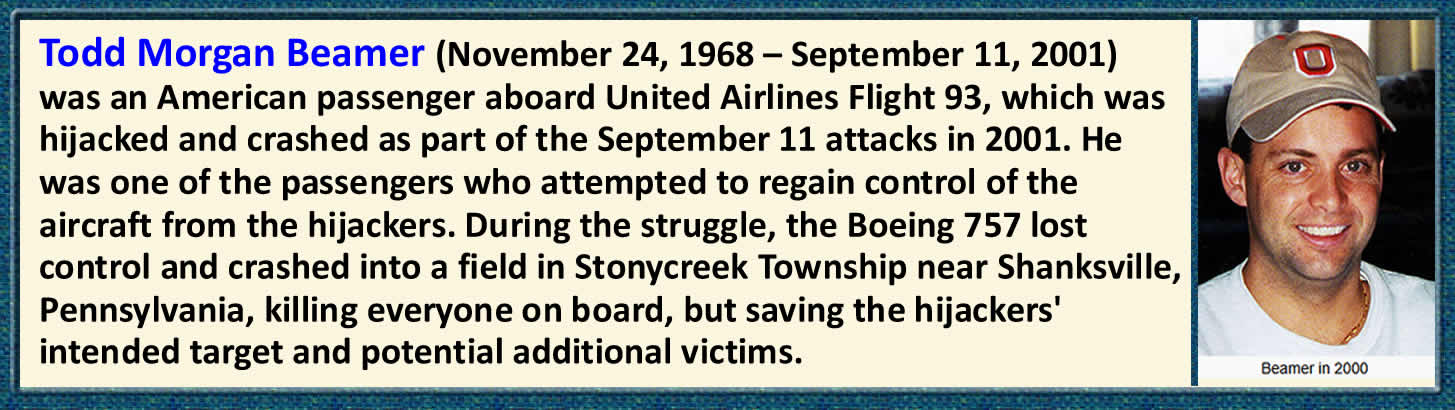
In his final moments, knowing he would never meet his unborn daughter, Todd Beamer could have begged for mercy. Instead, he organized a resistance, prayed with a stranger, and spoke two words the world would never forget.
It was September 11, 2001. United Airlines Flight 93 took off from Newark at 8:42 a.m., delayed and routine, heading for San Francisco. On board were 44 people: passengers, crew, and four hijackers. Among the passengers was Todd Beamer, thirty-two years old, a husband, a father of two young sons, and expecting a daughter in just a few months. He was traveling for work. He planned to return home and surprise his pregnant wife, Lisa, on her birthday. At 9:28 a.m., chaos erupted. Hijackers stormed the cockpit. The plane jolted violently. Screams echoed through the cabin. Within minutes, Flight 93 was turned around and redirected east, toward Washington, D.C. The pilots were gone. Control of the aircraft was no longer in the hands of those trained to fly it. Todd Beamer picked up the seat-back Airfone. He didn’t call his wife. He didn’t call a friend. He reached a customer service center and was connected to Lisa Jefferson, a GTE supervisor. What followed was a thirteen-minute call that would become part of history. Todd spoke with clarity and composure. He described the hijackers, the weapons, the layout of the cabin, the absence of the pilots. Lisa listened, documented everything, and stayed with him. As other passengers on Flight 93 made calls of their own, a devastating truth came into focus. The World Trade Center had been hit. The Pentagon had been struck. This was not an isolated hijacking. Their plane was part of a coordinated attack. Todd understood what that meant. Doing nothing would not save them. Compliance would not bring negotiations. The aircraft itself was intended to become a weapon. Whatever target lay ahead would suffer massive loss of life unless something changed. Todd asked Lisa to do something deeply personal. If he didn’t survive, would she call his family and tell them how much he loved them? He had every reason to be terrified. His wife was seven months pregnant. His sons were three years old and one year old. He would never meet his daughter. He would never see his children grow. But fear did not paralyze him. It focused him. Todd joined with other passengers, including Tom Burnett, Mark Bingham, and Jeremy Glick. They spoke quietly. They compared information. They weighed the risks. They understood the outcome either way. Remaining seated meant certain death and catastrophic consequences on the ground. Fighting back meant danger, injury, and likely death - but it also meant the chance to stop the attack. Over the phone, Lisa could hear the resolve forming.Todd returned to the call and asked one final thing. He asked Lisa to pray with him. At thirty thousand feet, facing the end of his life, he recited the Lord’s Prayer with a stranger. His voice did not shake. When the prayer ended, he paused, then turned back to the others. The 9/11 Commission later described the actions of the passengers of Flight 93 as the first successful counterattack of that day. It was not led by soldiers or commanders. It was led by ordinary people who refused to be passive. Todd Beamer’s daughter, Morgan, was born four months later. She grew up knowing who her father was and what he chose. His children learned that courage is not the absence of fear, but the decision to move forward despite it. Today, the Flight 93 National Memorial stands where the plane came down. Forty names are etched into white stone. People who refused to be turned into weapons. People who became protectors instead. “Let’s roll” became more than a phrase. It became a symbol of resolve; of choosing responsibility over surrender; of acting for others when the cost is everything. Todd Beamer boarded a plane expecting a normal day. Instead, he made a choice that altered history. He didn’t know how the story would end. He only knew who he wanted to be in that moment. That is what heroism looks like. |