 |
 |
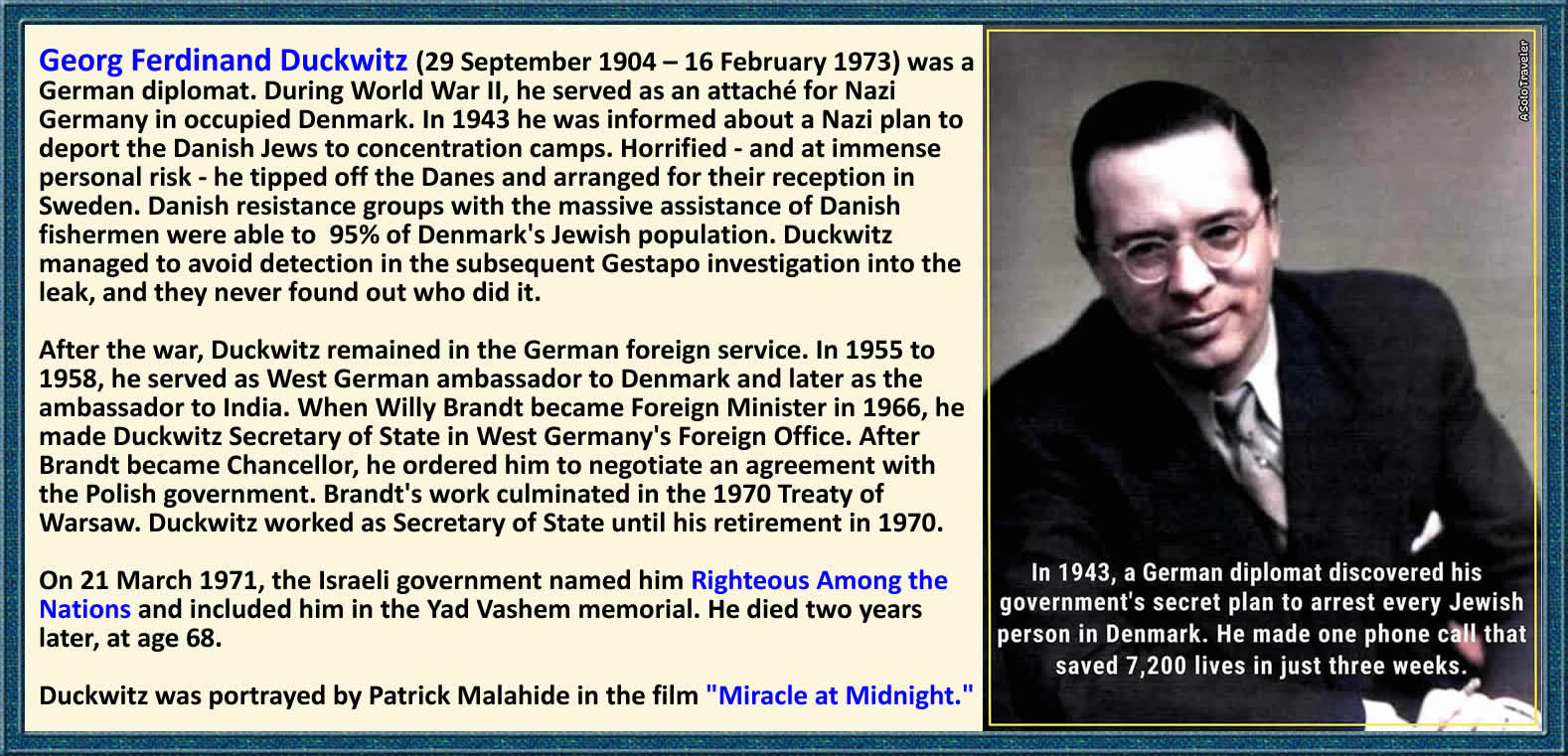
| Georg Duckwitz sat alone in his Copenhagen office, staring at orders that made his blood run cold. In 72 hours, Nazi forces would sweep through Denmark. Every Jewish family would be dragged from their homes, put on cattle cars, shipped to death camps. Georg was supposed to help make it happen.
He was a German diplomat, and these were his orders from Berlin. His job was to stay quiet and do what he was told. But Georg kept thinking about Mrs. Cohen, who sold flowers outside his office building, and the young father who walked his twin boys to school every morning, both kids chattering in Danish while holding their papa's hands.They were going to die - and they had no idea it was coming. Georg's hands trembled as he locked the classified papers in his desk drawer. He caught the next boat to Sweden with nothing but the clothes on his back and a plan that could get him executed. In Stockholm, he walked straight into government offices. His voice shook as he spoke to Swedish officials. Families who had lived in the same apartments for generations were suddenly grabbing their children and running into the night. Danish fishermen who had never spoken to a Jewish person in their lives became instant heroes. They loaded their small boats with scared families and pushed off into the black, freezing waters. Mothers held crying babies against their chests as the boats rocked violently in the waves. Elderly men clutched Torah scrolls. Teenagers said goodbye to their bedrooms forever. And the boats kept coming, night after night after night. Georg went to work the next morning as if nothing had happened. He sat in Nazi planning meetings, nodded when his colleagues talked about the upcoming "operation." Inside, his heart was pounding so hard he was sure everyone could hear it. When the SS finally arrived to arrest Denmark's Jewish population, they found something that stunned them: empty houses, unlocked front doors, breakfast dishes still sitting on kitchen tables. An entire community had disappeared. In three weeks, ordinary fishermen had smuggled 7,200 people to safety: whole families, newborn babies, great-grandparents who could barely walk - all because one man couldn't stay silent. The Nazis launched a massive investigation. They questioned everyone, they offered rewards for information. Georg never cracked: he filed his daily reports, attended his meetings, and carried his secret like a stone in his chest. He had saved so many people - and he never told anyone. After the war ended, when the truth finally came out, reporters called Georg a hero. He always said the same thing: "I just did what any decent person would do." But in that time most people didn't do what Georg did: they followed orders, stayed safe, looked the other way. Georg chose differently. Today, there are thousands of people living in Denmark, Sweden, America, and all over the world who exist because of that choice. They grew up, got married, had children and grandchildren, built businesses and families and beautiful lives - all because one person decided that saving strangers mattered more than saving himself. Think about that the next time you see something wrong happening and wonder if your voice matters. It does: a single person really can change everything. |
ANOTHER ACCOUNT: On September 19, 1943, Georg Ferdinand Duckwitz wrote in his diary. "I know what I have to do." He was a German diplomat — maritime attaché at the German embassy in occupied Copenhagen, a Nazi party member since 1932, a man who had spent his career navigating between commerce and the Reich's machinery in Scandinavia. He was not a hero by origin or by nature. He was a career official who had watched what his government was doing for years, had looked away when looking away was convenient, and had now arrived at a moment that apparently could not be navigated around. Werner Best, the Nazi Reich representative in Denmark, had told him about the order: a deportation — the entire Jewish population of Denmark, approximately 7,800 people, to be rounded up in a single night and transported to the camps. The date was set: the night of October 1 to 2, timed deliberately for Rosh Hashanah, the Jewish New Year, when German planners assumed every Jewish family would be home. Duckwitz wrote his four words and began moving. His first attempt was official. He flew to Berlin and made the case through channels — to German officials, to anyone who might halt the order from above. It was a logical first step and a complete failure. The deportation was approved. Hitler had signed it. There was nothing to be done through the machinery of the Reich. So Duckwitz went to Stockholm instead. He flew to Sweden on a pretext — ostensibly to discuss merchant shipping — and met privately with Prime Minister Per Albin Hansson. He told Hansson what was coming. He asked whether Sweden would be willing to receive Danish Jews who made it across the water. The crossing was short — Copenhagen sat less than twenty miles from the Swedish coast — but it was hazardous, across open water in October in small fishing boats, and worthless if Sweden turned the refugees back at the shore. Hansson gave his word within days: Sweden would receive them. This was before anyone had escaped, before the warning had even reached the Jewish community. Duckwitz had secured the destination before the journey existed. He came back to Denmark on September 28 — three days before the planned roundup — and met secretly in Copenhagen with Hans Hedtoft, chairman of the Danish Social Democratic Party. He told Hedtoft everything: the date, the scope, the plan. Hedtoft went immediately to C.B. Henriques, head of the Danish Jewish community, and to the acting chief rabbi, Marcus Melchior. Melchior went to his synagogue. On the morning of September 29 — the day before Rosh Hashanah — Melchior stood at the early morning service and told his congregation not to go home. He told them the Germans were coming. He told them to spread the word to every Jewish family they could reach and to find somewhere to hide. His congregation left the synagogue and fanned out across Copenhagen in every direction. What happened next was not organized by any government, any resistance command, or any central authority. It was organized by Denmark — by the country itself, person by person. Doctors hid Jewish patients in hospitals. Churches opened their doors. Families took in neighbors they barely knew. The Danish resistance coordinated passage to the coast. Fishermen whose boats had never carried anything more political than a catch agreed to load families into their holds and make the hour-long crossing in the dark. Over the following weeks, more than 7,200 Jews and nearly 700 of their non-Jewish family members were ferried across the water to Sweden. Some of the crossings were intercepted. A few hundred people — mostly elderly or sick, people who hadn't received the warning in time — were caught in the Gestapo sweep on the night of October 1 and deported to Theresienstadt. The Danes tracked every one of them by name through the Red Cross and sent food packages and delegations to check on their welfare. Of the 464 Danish Jews deported to Theresienstadt, 425 survived — a rate so far above any other nationality that historians have called it statistically extraordinary. Duckwitz also used his remaining contacts with German harbormasters to quietly discourage the naval patrols that might have caught more boats on the water. He did this without authorization and without telling anyone. He stayed at his post in Copenhagen for the rest of the occupation, unreported and unpunished. After the war, the question of what to do with Duckwitz was complicated. He had been a Nazi party member. He had served the occupation. His denazification hearings noted his limited post-1935 party activity and his documented opposition to the deportation, and he was cleared. He returned to the German diplomatic service. In 1955 he was appointed West German ambassador to Denmark — the same country he had warned twelve years before. He later became State Secretary of the West German Foreign Office under Foreign Minister Willy Brandt. He helped negotiate the 1970 Treaty of Warsaw, which normalized West Germany's relations with Poland and established the border that Germany had refused to recognize since the war. Brandt knelt at the Warsaw Ghetto memorial on the day the treaty was signed. On March 29, 1971, Yad Vashem recognized Georg Ferdinand Duckwitz as Righteous Among the Nations. He is the only German diplomat ever to receive the designation. He died in 1973 at the age of sixty-eight. In his diary on September 19, 1943, ten days before he walked into that meeting in Copenhagen, he had written: "I know what I have to do." He had known for ten days. He used every one of them. |