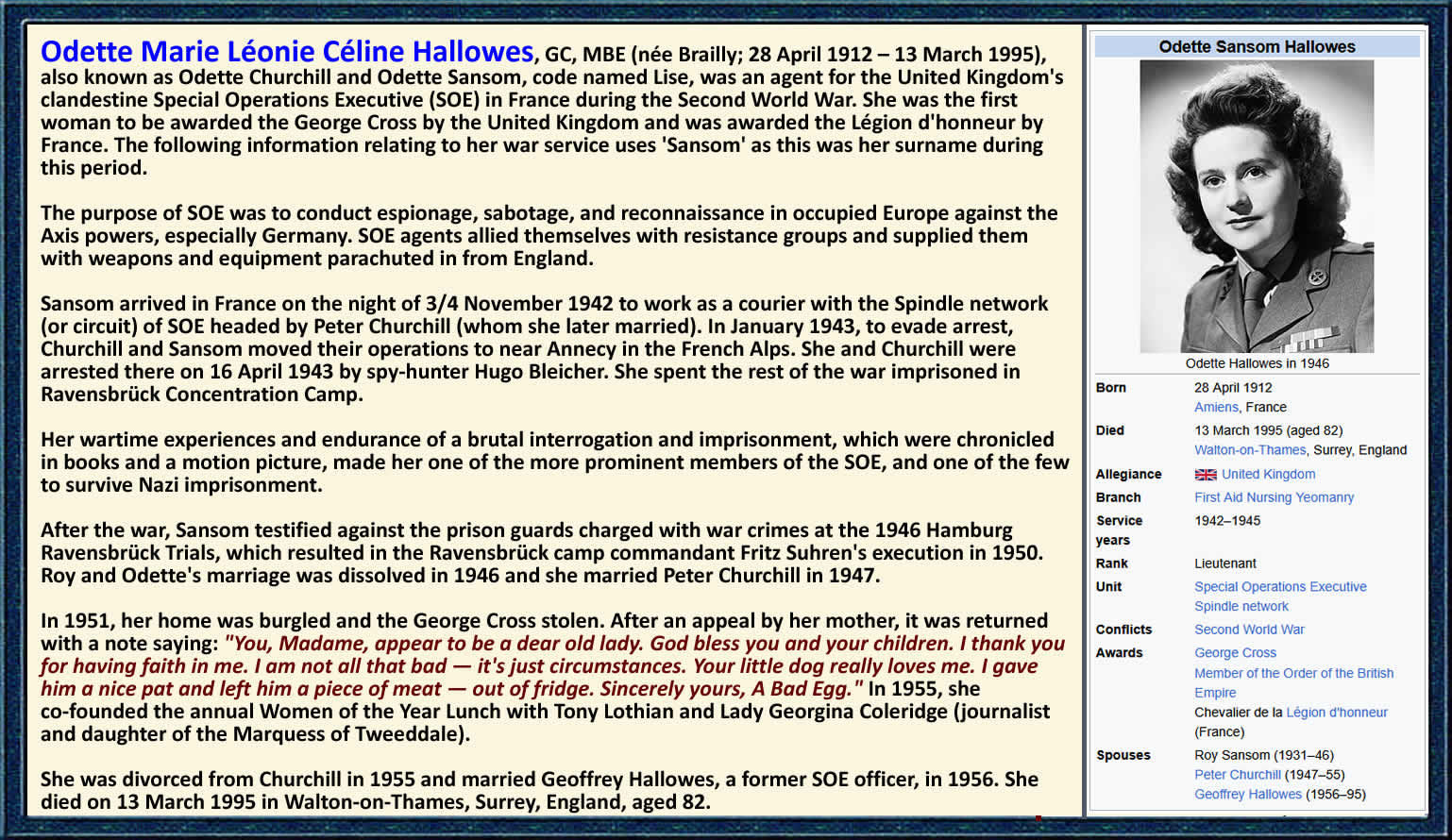
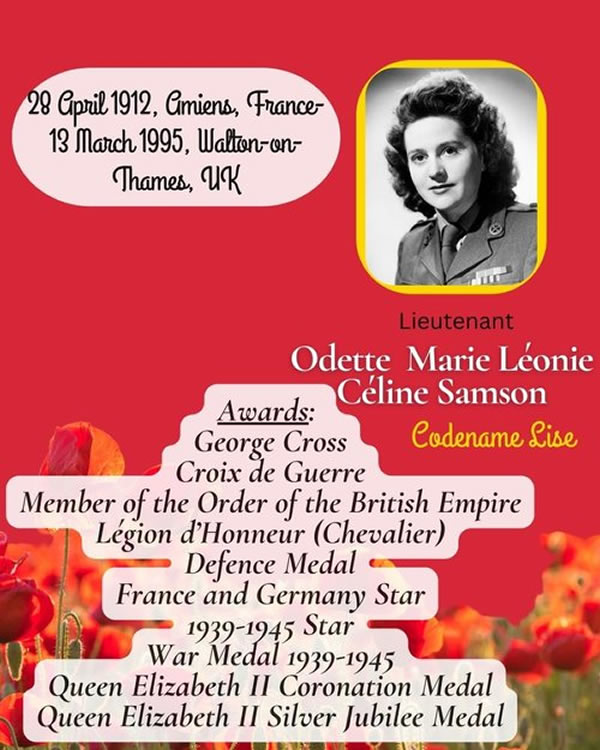
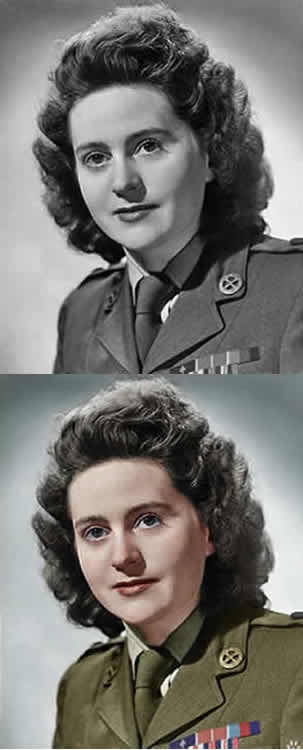
Odette Sansom: The Gestapo pulled out her toenails one by one, burned her with hot irons and condemned her to death, but she never spoke a single name.

England, 1942. Odette Sansom was a French-born housewife living in Britain with her three young daughters. She'd fled France in 1931, married an Englishman, settled into what should have been an ordinary life.Then Nazi Germany occupied France.And Odette decided that ordinary was no longer acceptable.She volunteered for the Special Operations Executive - the SOE, Britain's secret organization created to "set Europe ablaze" through sabotage, espionage, and resistance operations behind enemy lines. The SOE didn't recruit soldiers. They recruited ordinary people willing to do extraordinary, dangerous things: people who could blend in, people who spoke the languages, people who were willing to die if necessary.

Odette had three children. She was thirty years old. She had every reason to stay safe in England, but she volunteered anyway. After brutal training in espionage, weapons, sabotage, and survival, Odette was sent to occupied France in 1942. Her mission: work with the French Resistance, organize sabotage operations, gather intelligence, support networks of fighters working against Nazi occupation. She operated under the codename "Lise." She moved between cities, coordinating with resistance fighters, sending intelligence to London, helping organize operations that disrupted German supply lines. She worked alongside Peter Churchill (no relation to Winston), a British SOE officer running resistance operations in southeastern France. Together, they built networks, recruited agents, planned sabotage. For months, they operated successfully. Then, in April 1943, they were betrayed after a collaborator had infiltrated the resistance network. The Gestapo arrested Odette and Churchill. Odette was taken to Gestapo headquarters in Paris. The interrogations began immediately. The Gestapo wanted names. They wanted to know who else was working with the resistance. They wanted locations of safe houses. They wanted information about operations, about other agents, about the structure of SOE networks in France.

Odette refused to tell them anything, so they tortured her. They pulled out her toenails, one by one. They burned her back with a hot iron. They kept her in solitary confinement. They threatened her with execution. They told her that cooperation would save her life. She gave them nothing: not a single name, not a single location, not a single piece of intelligence that would compromise other agents or resistance fighters. Think about what this means. Odette knew that other SOE agents were operating in France. She knew resistance fighters' identities. She knew safe house locations. She knew operational details that, if revealed, would lead to arrests, torture, and executions of dozens - maybe hundreds - of people. The Gestapo knew she had this information. That's why they tortured her. And she refused: through pain most people can't imagine, through threats. through months of interrogation. She never spoke.

The Gestapo eventually gave up: they couldn't break her.They sent her to Fresnes Prison near Paris, then to Germany. In 1944, she was transferred to Ravensbrück - the Nazi concentration camp for women, north of Berlin, one of the most brutal camps in the system. She was classified as "Nacht und Nebel" - "Night and Fog," a designation for prisoners the Nazis wanted to disappear without trace. These prisoners were to be executed in secret, with no records kept. Odette was condemned to death. For over a year, she waited in Ravensbrück, expecting execution at any moment. She watched other prisoners die from disease, starvation, execution. She endured horrific conditions - minimal food, no medical care, brutal treatment. She survived because she convinced the camp commandant that she was related to Winston Churchill .It was a lie - Peter Churchill was not related to the Prime Minister, but the lie worked. The commandant thought she might be valuable as a hostage.In April 1945, as Allied forces closed in and the Nazi regime collapsed, the Ravensbrück commandant - now terrified of war crimes prosecution - tried to use Odette as a bargaining chip. He personally drove her toward American lines, hoping she could help him negotiate.Instead, when they encountered American forces, Odette identified the commandant as a war criminal. He was arrested and she was liberated. After nearly two years of captivity, torture, and waiting to be executed, Odette Sansom was free.

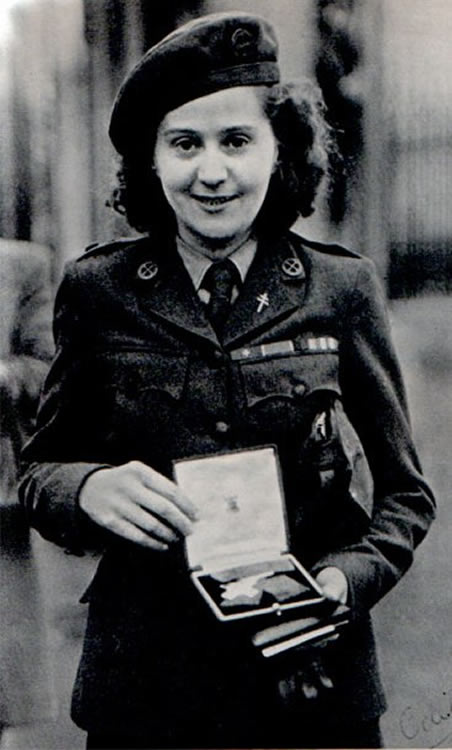
When she returned to Britain, the full scope of what she'd endured became clear: the torture, the refusal to break the protection of other agents and resistance fighters at the cost of her own suffering. In 1946, Britain awarded Odette the George Cross - the highest civilian decoration for gallantry, equivalent to the Victoria Cross for military personnel. The citation explained why: for her courage under torture, for her refusal to betray her comrades, for her extraordinary moral strength when she had nothing left except her principles. She was one of only a handful of women to receive the George Cross during or immediately after WWII. But then something almost unbelievable happened. In the early 1950s, someone broke into Odette's home and stole her George Cross medal. It was devastating. The medal represented her survival, her courage, her refusal to break. It was proof of what she'd endured and overcome. Months passed. The police investigation went nowhere. Then, one day, a package arrived in the mail. Inside was the George Cross, and a note. The thief apologized. He said they hadn't realized what he'd stolen until he researched the medal. He'd learned Odette's story - the torture, the camps, the refusal to break - and he couldn't live with having taken it - sothe mailed it back anonymously. Even the thief recognized the weight of what that medal represented.

Think about Odette's story for a moment. She wasn't a trained soldier. She was a mother who decided that staying safe while others fought was unacceptable. She volunteered for work with an extraordinarily high mortality rate. Many SOE women sent to France were captured, tortured, and executed. She endured torture that would break most people. And she protected every single person she could have betrayed. She survived two years in Nazi captivity, including over a year in Ravensbrück concentration camp, under sentence of death. She convinced a Nazi commandant she was valuable enough to keep alive. She identified that same commandant as a war criminal the moment she was free. And when her medal was stolen, even the thief couldn't keep it once he learned what she'd done to earn it.

Odette Sansom Hallowes lived until 1995 when she was 82 years old. She spent decades after the war speaking about the resistance, honoring fallen comrades, embodying quiet dignity. She never sought fame. She insisted she'd only done what anyone should do - refuse to betray others, no matter the cost. But that's not true. Most people would break under Gestapo torture. Most people would give up names to stop the pain. Most people would talk. Odette didn't: not once, for months. That's not what "anyone" would do. That's what a person of extraordinary courage does. Odette Sansom Hallowes, GC (1912-1995) - the housewife who proved that the strongest weapon against tyranny isn't violence - it's the refusal to break, no matter what they do to you.