 |
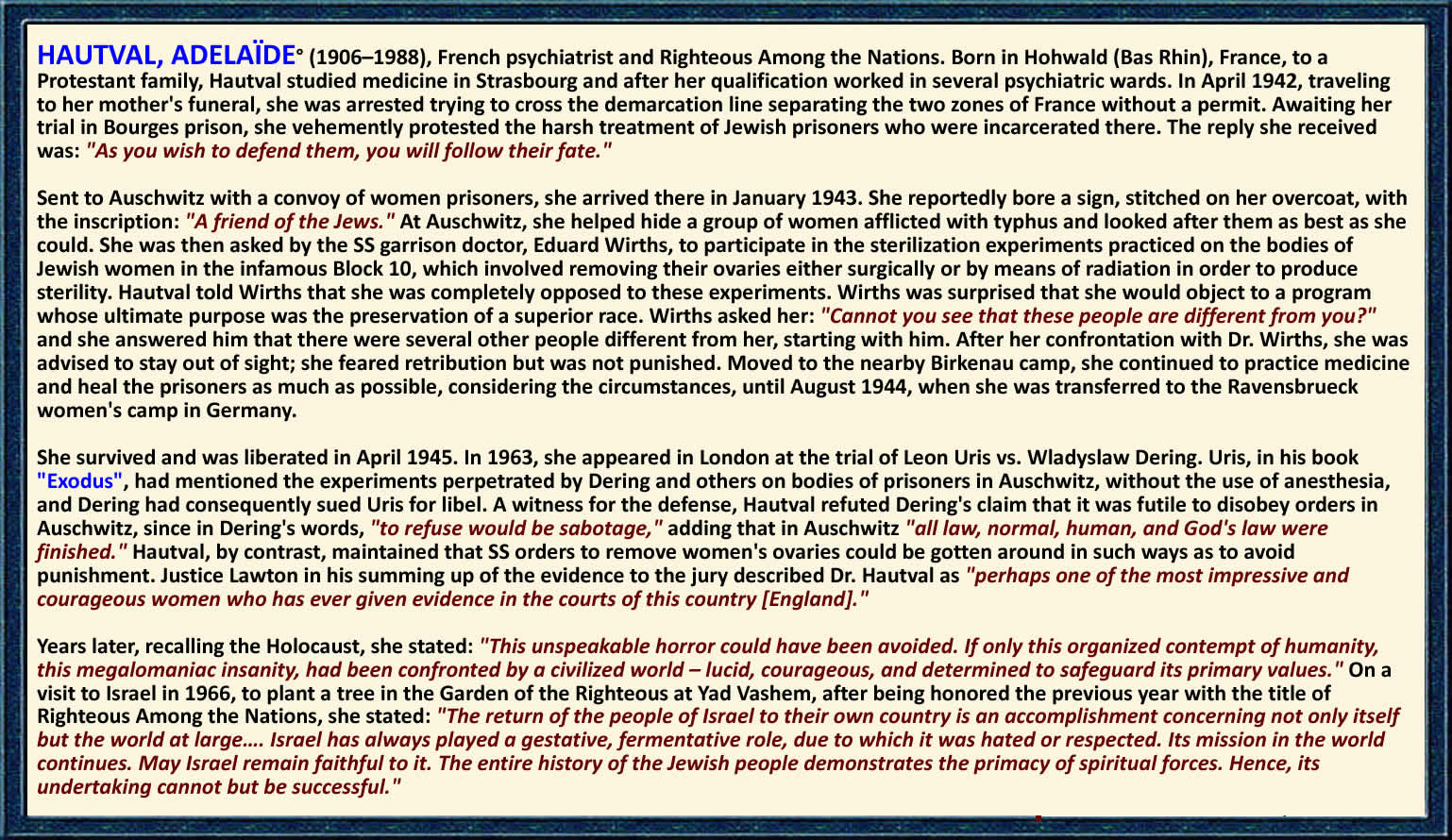
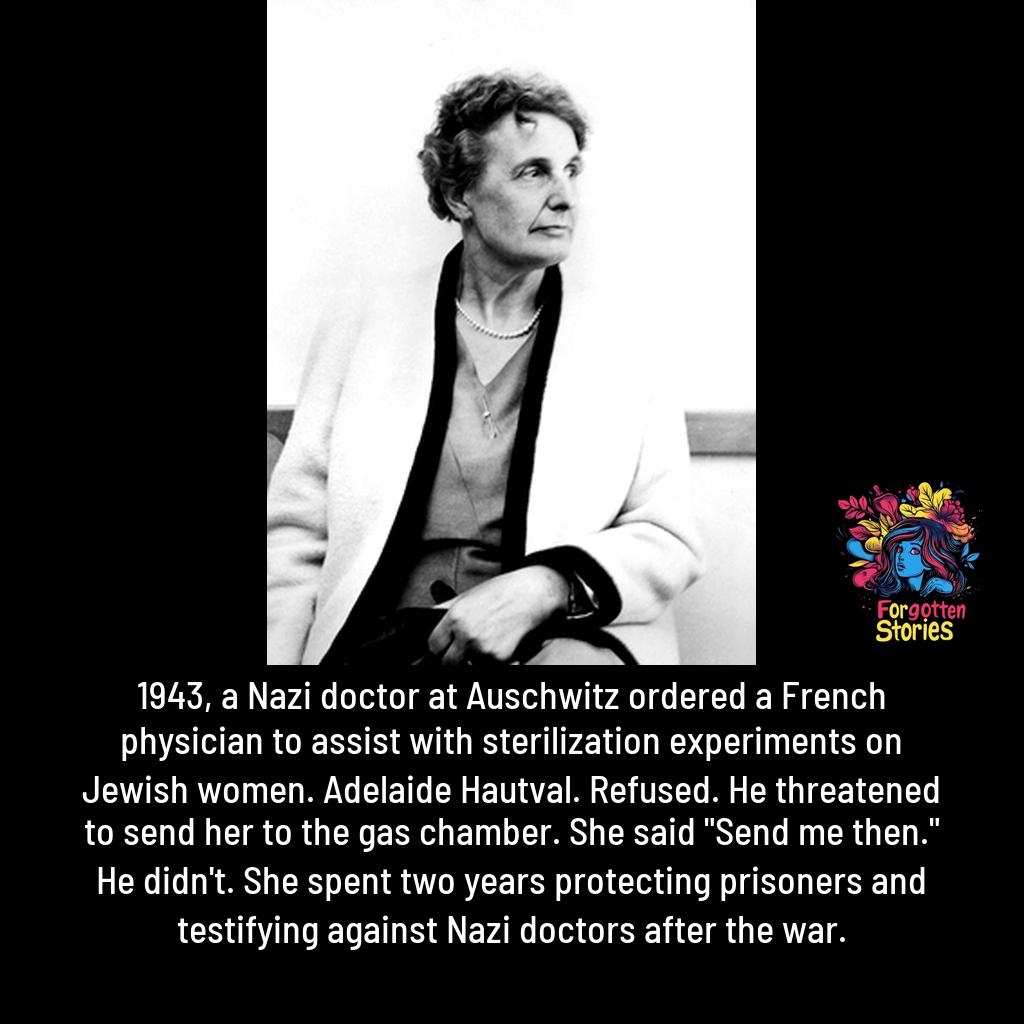
| Dr. Adelaide Hautval looked the Nazi doctor in the eye and said "No." Auschwitz-Birkenitz, 1943. She was 36 years old: a French Protestant doctor - imprisoned for defending Jews. The Nazi doctors had orders: perform sterilization experiments on Jewish women, test methods, document results, report findings. They needed help: needed another doctor, someone to assist. They ordered Adelaide. "You will help with the experiments." Adelaide looked at the women lined up. Terrified. Knowing what was coming. Knowing they'd be mutilated in the name of science. "No," Adelaide said. "I won't do it." The Nazi doctor stared at her. Nobody said "No." at Auschwitz. Nobody refused orders. "You'll be punished: sent to the gas chamber." Adelaide didn't flinch. "Then send me. I still won't do it." The doctor backed down: didn't send her to die, just sent her back to the barracks. Adelaide had won. By refusing to obey. By being willing to die rather than help torture prisoners. For the next two years, she kept refusing. Kept protecting. Kept saving lives in secret. Here's how she ended up there. April 1942. Adelaide was traveling through France: needed to cross the demarcation line: the border between occupied and unoccupied France. She didn't have the right permit and was stopped by police. While waiting, she saw German soldiers harassing an old Jewish woman, forcing her to wear the yellow star, mocking her. Adelaide intervened. "Leave her alone. She's done nothing wrong." The Germans arrested Adelaide. "You're defending Jews? You'll share their fate." They pinned a yellow star on her coat and wrote across it: "Friend of Jews." Adelaide wore it proudly. Never tried to remove it. "If standing with Jews is a crime, I'm guilty." They sent her to prison, then to concentration camps: first Pithiviers, then Beaune-la-Rolande, then Auschwitz-Birkenau. Adelaide was a doctor. The Nazis needed doctors, so they put her to work in the camp infirmary. But they gave her impossible choices: help with experiments or die. Adelaide chose a third option: refuse, and dare them to kill her. They didn't. They needed doctors too badly, so they let her live - and she used that reprieve to save others. She treated prisoners in secret, stole medicine, hid sick women from selections, protected Jewish prisoners from the worst brutality. When Nazi doctors wanted to experiment on women, Adelaide blocked them. "Those women are too sick. You'll kill them before you get results." Lies: the women were healthy, but Adelaide was protecting them. The Nazi doctors believed her, picked different victims. Adelaide saved those women by sacrificing others - impossible choices, daily. In 1944, Adelaide was transferred to Ravensbrück: another concentration camp, women only, just as brutal. She kept working, kept treating prisoners, kept protecting when she could. The war ended in May 1945. Adelaide survived: she walked out of Ravensbrück alive. She was 38 years old: had spent three years in concentration camps: had refused Nazi orders dozens of times - should have died. After the war, she went back to France as a doctor, back to normal life. But prosecutors found her, wanted her to testify against Nazi doctors, against the ones who'd experimented on prisoners. Adelaide agreed: testified at multiple trials, Nuremberg, Frankfurt, at other war crimes proceedings. She told the truth about the experiments. about the doctors who'd murdered in the name of science, about her refusal to participate. Defense lawyers attacked her. "You're lying. German doctors wouldn't do such things." Adelaide never wavered. "I was there. I saw it. I refused to help. These are the facts." Her testimony helped convict multiple Nazi doctors: sent them to prison, some to execution. In 1965, Yad Vashem honored her as Righteous Among the Nations - for protecting Jewish prisoners, for risking her life to refuse Nazi orders. Adelaide didn't want the honor. "I just did my duty as a doctor. As a human being." She continued practising medicine until she retired: psychiatry, helping people heal from trauma. Many of her patients were camp survivors. Dr. Adelaide Hautval died in 1988 at the age of 81 - in France, surrounded by family.
Thousands of people attended her funeral: former prisoners, their children, their grandchildren - all alive because Adelaide had protected their mothers and grandmothers.
One woman said: "She saved my mother in Auschwitz: hid her during a selection. I exist because Dr. Hautval said no to the Nazis." Here's what makes her story so incredible.
Adelaide had every reason to cooperate, every reason to help the Nazi doctors, every reason to save herself.
She was already imprisoned, already wearing the Jewish star, already condemned.
Helping with experiments wouldn't have saved her, but refusing could have killed her.
She refused anyway: not once but repeatedly - for two years; dared them to kill her for it. She performed a different kind of resistance: not sabotage, not assassination, not escape - just refusing to cooperate, saying no, being willing to die for that refusal. And living to testify about it afterward. Most concentration camp resisters died, but Adelaide survived, testified against Nazi doctors and helped convict them - then lived another 43 years healing trauma, helping survivors, never seeking glory. Today, most people have never heard of Adelaide Hautval. They don't know about the French doctor who said "No" to Mengele's colleagues, who protected Jewish women, who survived to tell the truth. There's a small memorial to her in France, a plaque at Yad Vashem. A few books mention her testimony, but she's mostly forgotten outside of Holocaust scholars and medical ethics courses. The woman who refused to torture prisoners, who dared Nazis to kill her for it, who |
 |