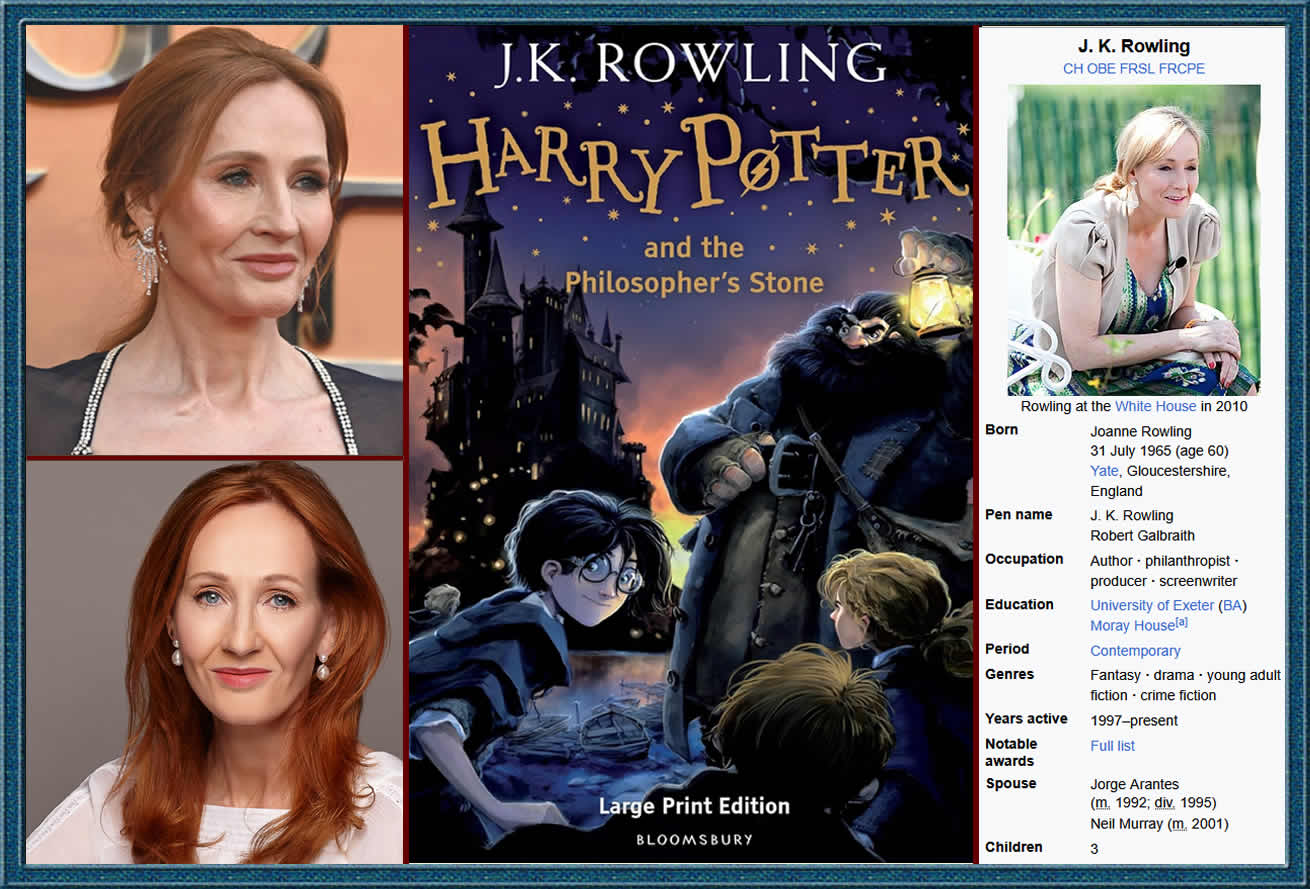
It was 1990, and Joanne was on a delayed train from Manchester to London when the idea arrived - not slowly, not as a vague feeling, but whole and sudden and fully formed, the way the most important things sometimes do: a boy who didn't know he was a wizard; a school for magic; a world hidden inside the ordinary one. She was too anxious to ask anyone for a pen, so she sat perfectly still for four hours, terrified that if she moved, the idea might dissolve. She held the entire thing in her head - every character, every feeling, the shape of the whole story - and by the time the train pulled into King's Cross, she knew exactly what she needed to write. She jus t had no idea what it was going to cost her to write it. Joanne had been writing since she was six years old. The first story was about a rabbit named Rabbit. By eleven, she had written a novel. By her teens, she understood something at a deep, wordless level: writing wasn't something she did for pleasure. It was something she did because she couldn't stop. When she was fifteen, her mother Anne was diagnosed with multiple sclerosis - a disease that takes everything slowly, one piece at a time. Joanne watched it happen for ten years while she went to university, worked in London, and quietly began sketching the outline of a boy wizard in the margins of her work notebook. On New Year's Day, 1991, Anne Rowling died. She was forty-five years old. Joanne was twenty-five. She had been writing Harry Potter for six months. She had never told her mother about it. That silence shaped every page that followed. The magical mirror in the books - the one that shows you your deepest desire - came directly from what Joanne would have seen in it: her mother, alive. The theme of a child defined by loss runs through all seven books not as a storytelling device, but as a wound that never fully healed, transformed into something millions of children would one day read without ever knowing where it came from. She moved to Portugal. She married. She had a daughter named Jessica. The marriage became dangerous, and in late 1993, she left with her baby and came back to Britain. She arrived in Edinburgh with a child, a suitcase, and half a manuscript. She was twenty-eight. She had no job, almost no money, and one plan: finish the book. She applied for welfare. She was granted it. She moved into a small flat that was never quite warm enough against the Scottish winter, and the depression that had been waiting quietly moved in with her. She would describe that period, years later, as the darkest of her life: not sadness - something deeper than sadness - a numbness she could not always see through. She got help. She kept going. She said later that she had understood she was at the very bottom - but also that the bottom was solid. Something to push against. So she pushed. Every day, she bundled Jessica into her stroller and walked through Edinburgh until the baby fell asleep. Then she went to a café - wherever she could sit longest on the price of one cup of coffee - and she wrote - by hand. with her daughter sleeping beside her, because the cafés were warmer than the flat and she needed to save money on heating. When she finally finished the manuscript, she typed the whole thing up herself because she couldn't afford to pay for photocopies. Then she sent it out. Twelve literary agents rejected it: too long, too complicated. Children's books don't sell like that. The thirteenth said "Yes." That agent sent it to publishers. Eight rejected it. Then four more. Then it landed at a small London publisher called Bloomsbury. The chairman took the first chapter home and gave it to his eight-year-old daughter Alice to read. Alice read it. Then she demanded the rest - immediately, with the particular urgency of a child who has just discovered something real. Bloomsbury offered Joanne a contract. The advance was £1,500 - roughly $2,000. Her editor called her in and told her, kindly but honestly, that she should not quit her day job. Children's books, he explained, did not make real money. The most she could reasonably expect was a modest readership and maybe enough to cover a month's rent. She thanked him, went home and kept writing. There was one more thing. The publisher believed that a woman's name on an adventure story might put boys off reading it. They asked her to use initials instead. She had no middle name, so she borrowed one from her grandmother: Kathleen. And Joanne Rowling became J.K. Rowling - a name invented specifically so that boys would not put the book down before the first page. "Harry Potter and the Philosopher's Stone" was published on June 26, 1997. Within a year, it was everywhere. Seven books followed over ten years. A generation grew up inside them. Children who had never read for pleasure were staying up past midnight with flashlights under their covers to get to the next chapter. Libraries reported numbers they had never seen before. Teachers said the books had brought children back to reading at the exact moment reading seemed to be losing. The films came. The theme parks came. The world came. Forbes eventually named Joanne Rowling a billionaire. She began giving the money away - steadily, quietly, and in extraordinary amounts: to poverty charities, to single-parent organizations, to literacy programs. She funded a neurology clinic at the University of Edinburgh, named for her mother, with a donation of over £10 million - the largest single gift the university had ever received - dedicated entirely to finding a cure for the disease that had taken Anne Rowling at forty-five. By 2007, Forbes removed her from the billionaire list. She had given away enough to fall below the threshold. She became the first person Forbes had ever removed from the list specifically because of charitable giving. Years later, Joanne wanted to know whether her writing could succeed without her name. She wrote a crime novel under the pseudonym Robert Galbraith and submitted it to publishers - no biography, no reputation, nothing. It was rejected. One of those rejection letters came from a publisher who had also, years earlier, rejected Harry Potter and the Philosopher's Stone. The same instincts. The same door, closed twice - to the same author, without ever knowing it. The novel was eventually published. A newspaper uncovered the real identity through literary analysis software. "The Cuckoo's Calling" became a bestseller overnight. Joanne kept all her rejection letters in a box in her attic. In 2016, she posted two of them on social media. Not for revenge, she said - for encouragement. She signed the post simply: "For every writer who needs to hear it - keep going." She was on a delayed train in 1990, with no pen and an idea she was terrified of losing. She held onto it anyway. And so did we. |