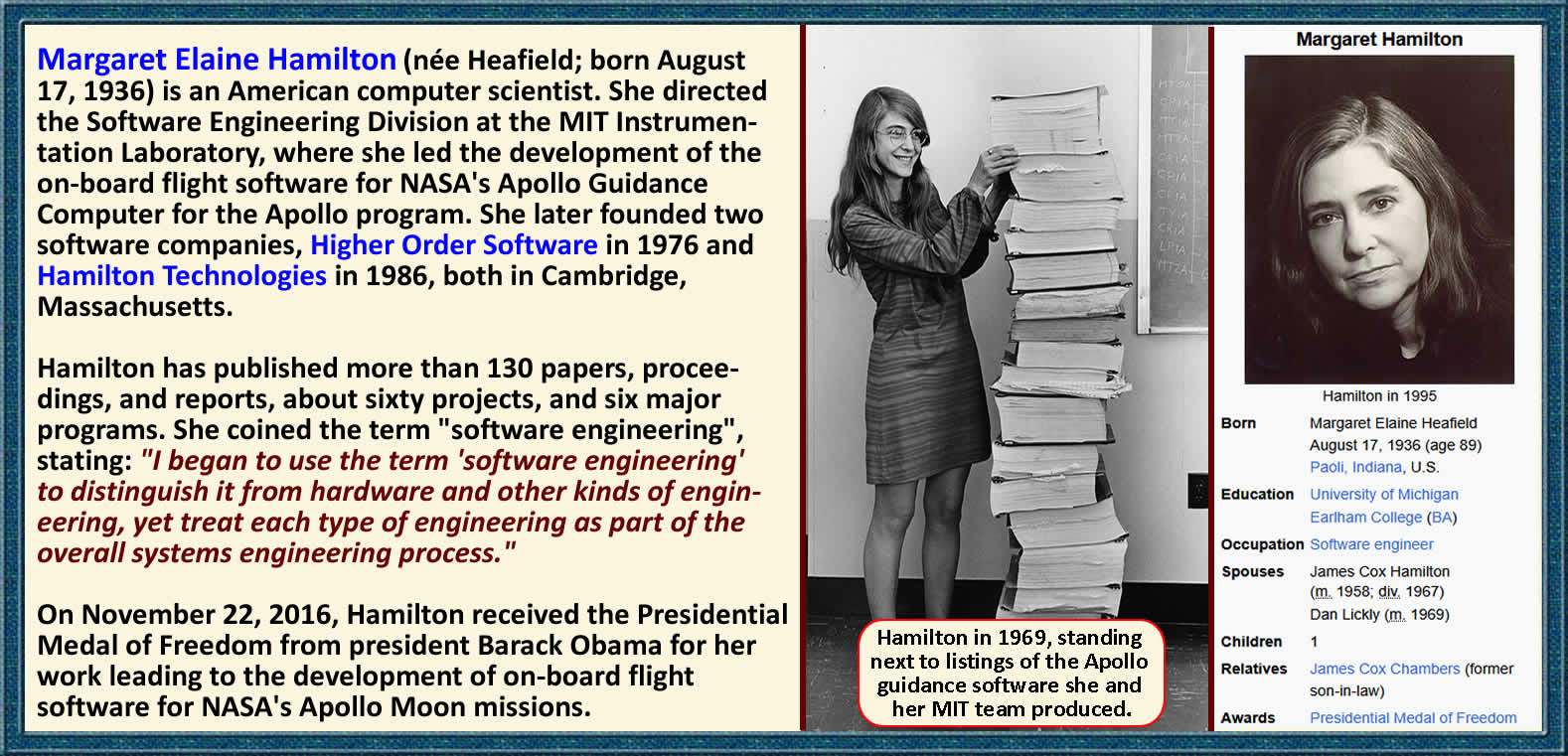
In 1960, a young woman with a mathematics degree and no programming experience walked into MIT looking for temporary work. Her husband was in law school. Money was tight. She figured she'd stay a year, maybe two.
She stayed long enough to save the moon. When Margaret arrived, "programmer" was not considered a serious title. Hardware engineers — the people who designed circuits, built rocket systems, welded the machinery of space travel — were the real professionals. Writing computer instructions was seen as support work, detail work, administrative, something women could do precisely because no one thought it mattered much. Margaret looked at that assumption and saw it for what it was: dangerously wrong. She understood something the hardware engineers hadn't fully reckoned with yet. Without the software working perfectly, nothing else worked at all. The spacecraft was metal. The software was the mind inside it. And nobody was treating that mind with anything like the seriousness it deserved. She began pushing for rigor, discipline, real engineering standards applied to code. When she raised these concerns, she was dismissed: politely, sometimes, but often not politely at all. So she did something quietly radical. She started calling what she did "software engineering" — deliberately borrowing the language of the profession that had excluded her, insisting through terminology alone that her work deserved the same respect. People rolled their eyes: engineering was bridges and rockets - it wasn't typing. She ignored them and got to work. NASA's Apollo program was attempting something that had never been done. The computer guiding astronauts to the moon would have to operate completely on its own — no live corrections from Earth, no safety net, no second chances. It had less usable memory than a modern digital greeting card - and it had to be perfect. Margaret's team had to think about every possible failure before it happened. What if an astronaut pressed the wrong button at the wrong moment? What if sensors contradicted each other? What if the computer got overwhelmed with competing demands? Her answer was to build intelligence into the system itself. She designed a priority system — a hierarchy of decisions that allowed the computer to recognize when it was overloaded and automatically shed non-essential tasks to protect the ones that kept people alive. She embedded error detection throughout the code. She built in restart capabilities. She prepared for disasters that hadn't happened yet, running endless simulations, fighting for every line of protective code. Some managers thought she was being excessive. The missions would be planned. The astronauts would be trained. Why waste precious memory on unlikely scenarios? Margaret fought for every one of them anyway. July 20, 1969. Neil Armstrong and Buzz Aldrin were three minutes from the lunar surface. Six hundred million people around the world were holding their breath. Then the alarms started. Warning lights flooded the cockpit. The guidance computer was drowning — someone had left the rendezvous radar running, a system only needed later for docking. It was flooding the computer with unnecessary data at the exact moment the machine needed every bit of processing power it had to land the spacecraft safely. Mission Control froze. This alarm had barely appeared in years of simulations. Should they abort? Call the landing off with the moon surface so close they could see the craters? But Margaret had been here before — in her mind, in her simulations, in the scenarios she'd spent years imagining. Her priority system activated automatically. The computer recognized the overload, identified what was essential, and began shedding everything that wasn't. Navigation: kept; life support: kept; thrust control: kept; radar data that wasn't needed for another hour: dropped. The machine was making decisions. Exactly the decisions it had been designed to make. A young guidance officer named Jack Garman, who had memorized alarm codes in Hamilton's training simulations, recognized the number on his screen: 1202. It didn't mean failure. It meant the system was doing precisely what she had built it to do. "We're go on that alarm." The warnings sounded six times in those final minutes. Six times, her code adapted and held. At 4:17 PM, a voice crackled across 240,000 miles of silence. "The Eagle has landed." Margaret Hamilton was not at Mission Control when it happened. She was not on the broadcast. She was back at her lab, trusting that years of quiet, unglamorous, dismissed work had been enough. It had been more than enough: it had been everything. Armstrong and Aldrin became legends overnight. The flight director was celebrated. Mission Control passed into history. The woman whose code had made the actual life-or-death decisions during those six terrifying alarms? Most of the world never learned her name. She kept working, kept building, founded companies, consulted on aerospace systems. In 2003, NASA gave her a special recognition award. In 2016 — 47 years after Apollo 11 — President Obama placed the Presidential Medal of Freedom around her neck.
She received the nation's highest civilian honor in the same decade most people first heard her name.
But here is what cannot be taken from her: She was told her work wasn't engineering, so she defined what engineering would become.
She didn't go
to |