Marilyn's life was ultimately tragic,but she left an unforgettable mark on Hollywood. She played upon her blondness of course, but I think her intelligence, talent and basic humanity are underrated. She was smart, sensitive and intelligent, but had many insecurities and even demons. For me her tragedy was not to have found a loving and understanding partner. To take her own life, she must have felt alone. Rest in Peace, Marilyn.

"She was a wonderful girl, really. A very nice girl." — Groucho Marx to Hugh Downs in 1963

"I want to tell you about Marilyn Monroe. When we did one picture in which she had a bit. She got a hundred dollars for one day's work. You can imagine how long ago this was. And Lester Cowan, who was producing the picture, he called me up because I was going to do the scene with Marilyn. He called me up and he said, 'I wish you'd come over to the studio tomorrow, to my office, because we're going to try out three girls for the part in this picture.' I think it was called Love Happy or something. Terrible picture. So, I sat there with Lester. And then the three girls were there. I was introduced to them. And he said, 'Now the first girl, walk.' And she walked across from one end to the other. And I say, 'Very nice.' He says, 'Now the second girl, walk.' And she did it too.

He says [to the third one], 'Now you walk across.' And he says to me, 'Which one do you like the best?' And I say, 'You're kidding. aren't you? How can you take anybody except that last girl?' The whole room revolved when she walked. And it was Marilyn Monroe. And she got a hundred dollars. And then, we quit shooting at five. And she got twenty-five dollars extra for going to a couple of gas stations. They were plugging some kind of gas or something which was part of the picture or something. And she got twenty-five dollars extra for that. They took snapshots of her from six to eight o'clock."

Marilyn Monroe, with her irresistible charm, is said to have once quipped to Einstein: "Imagine if we had a child together — he'd be as beautiful as me and as smart as you." To this, the father of relativity is rumored to have replied: "Well, I think he'd end up with my looks and your brains." At the time, it wasn’t widely known that Marilyn Monroe’s IQ was actually 165 — five points higher than that of the so-called ‘greatest genius of all time’.

Norma Jeane Baker (1926-1962), better known as Marilyn Monroe, was more than just a glamorous icon. She was an avid reader, with a home library boasting around a thousand books. She spent countless hours absorbed in literary works, poetry, theater, and philosophy. Her spirit was fueled by a deep love for life, an insatiable curiosity, and an unquenchable thirst for knowledge. Here are some more quotes from this incredible woman:

"I don't feel like spring. I feel like a hot red autumn."
"Laugh when you're sad. Crying is too easy."
"One of the best things that happened to me is that I am a woman. All women should feel that way."
"No one told me I was beautiful when I was a child. All children should be told they're beautiful, even if they're not."
"It's better to be alone than miserable with someone."
"Disappointments make you open your eyes and close your heart."
"Imperfection is beauty, madness is genius, and it's better to be ridiculous than to be boring."
"I'm a little girl in a big world trying to find someone to love."
"Don't hang your head. Keep your forehead up and smile, because life is a beautiful thing and you have many reasons to smile."
"If I had followed all the rules, I wouldn't have gotten anywhere."
"It's easier to love a man than to live with him."
"I have never cheated anyone. Sometimes I let men make their own mistakes."
"I've never left someone I believed in."

In 1953, Marilyn Monroe filmed "River of No Return", a breathtaking western set amidst the rugged beauty of the Canadian Rockies. Directed by Otto Preminger, the film featured Monroe as Kay Weston, a saloon singer swept into a perilous adventure with Robert Mitchum's character. The movie highlighted Marilyn's evolving versatility, showcasing not just her sultry charisma but also her ability to convey emotional depth in a challenging role.

The production was notoriously difficult, with Monroe suffering an ankle injury during a river scene. Despite the setback, she continued filming with remarkable determination, earning the respect of the cast and crew. Though "River of No Return" received mixed reviews upon its 1954 release, it became a pivotal moment in Monroe's career, cementing her as a leading star of Hollywood's Golden Age. Her performance balanced vulnerability and strength, leaving an indelible mark on the genre and her enduring legacy.

"She was supposed to smile for the cameras, not sit at their table.

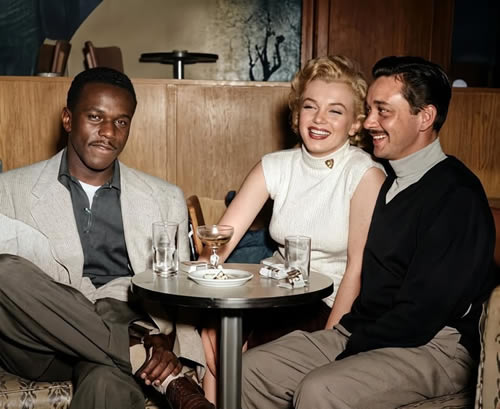
But in 1952, Marilyn Monroe walked into a club in Los Angeles where almost no one who looked like her ever went and she didn't just stay for one drink.
The club was in a predominantly Black neighborhood that much of Hollywood avoided entirely. Marilyn, however, wasn't a stranger to those streets. She had grown up moving between foster homes, including one with a family in Watts whose father worked for the post office. While other rising starlets kept a careful, camera-ready distance from communities of color, Marilyn didn't.

By 1952, she was standing on the edge of something enormous. She had just finished filming Don't Bother to Knock and was about to step into the role that would solidify her stardom: Gentlemen Prefer Blondes. Beside her through it all was William Travilla, her main costume designer and one of the few people in Hollywood she truly trusted. That night, the two of them did something quietly radical. They went out to a club frequented almost entirely by Black patrons. They laughed, enjoyed their drinks, and somewhere in the room, a camera captured them sitting beside a Black man whose name was never recorded for history.
For Marilyn, it was simply an evening out with friends. For the studio, it was a problem. When executives saw the photo, they were furious. In an era when segregation still held firm and anti-miscegenation laws were active in much of the country, a photo like that could threaten a career. It could alienate audiences and become the exact kind of scandal studios spent millions trying to prevent. Travilla and his longtime partner, Bill Sarris, later put it simply: they "got in trouble with their employers" over that photograph. In the studio system of the 1950s, there was no such thing as a private night out. Someone was always watching, and crossing social racial boundaries carried real consequences.

What makes this moment stand out isn't just that the photo exists it's how Marilyn handled it. She didn't apologize for the evening, she didn't distance herself from Travilla, and she didn't let him take the fall alone. While the exact conversations behind closed doors at 20th Century Fox remain private, the outcome is clear: Travilla kept his job, Gentlemen Prefer Blondes moved forward as planned, and Marilyn's career continued its rapid rise. This was far from an isolated moment. Two years earlier, on the set of All About Eve, she had been warned to keep Lincoln Steffens' autobiography a work exploring social inequality and political corruption out of sight of studio executives. She kept reading it anyway.

Throughout her career, while many of her peers remained silent on issues of race and social justice, Marilyn formed genuine friendships with Black artists, musicians, and intellectuals. She understood, in a deeply personal way, what it felt like to be dismissed, used, and told where she was allowed to belong. The photo from that night stayed out of the public eye for decades. It didn't resurface until the 2000s as part of The Travilla Tour exhibit. When it finally emerged, it added depth to the polished, familiar image of Marilyn Monroe the world thought it knew. Here was a woman who chose her company based on character, not industry expectations. Travilla went on to design costumes for eight of Marilyn's films, including the iconic white dress from The Seven Year Itch and the famous pink gown from Gentlemen Prefer Blondes. Their close friendship endured, and before she left 20th Century Fox in 1956, she signed a calendar for him: "Billy, dear, please dress me forever. I love you, Marilyn."
That wasn't just appreciation for his designs. It was a recognition that he saw her as a full person rather than a commercial product and when it counted, she offered him the exact same loyalty.

Marilyn Monroe's life remains complex. She was often underpaid, overexposed, and worn down by the system that built her stardom. Yet moments like this offer a clearer view of who she was: a woman with quiet convictions, willing to take real risks for the people she cared about. Not every star's brightest moment happens under the studio spotlights. Some happen in a room no one was ever supposed to photograph at all.