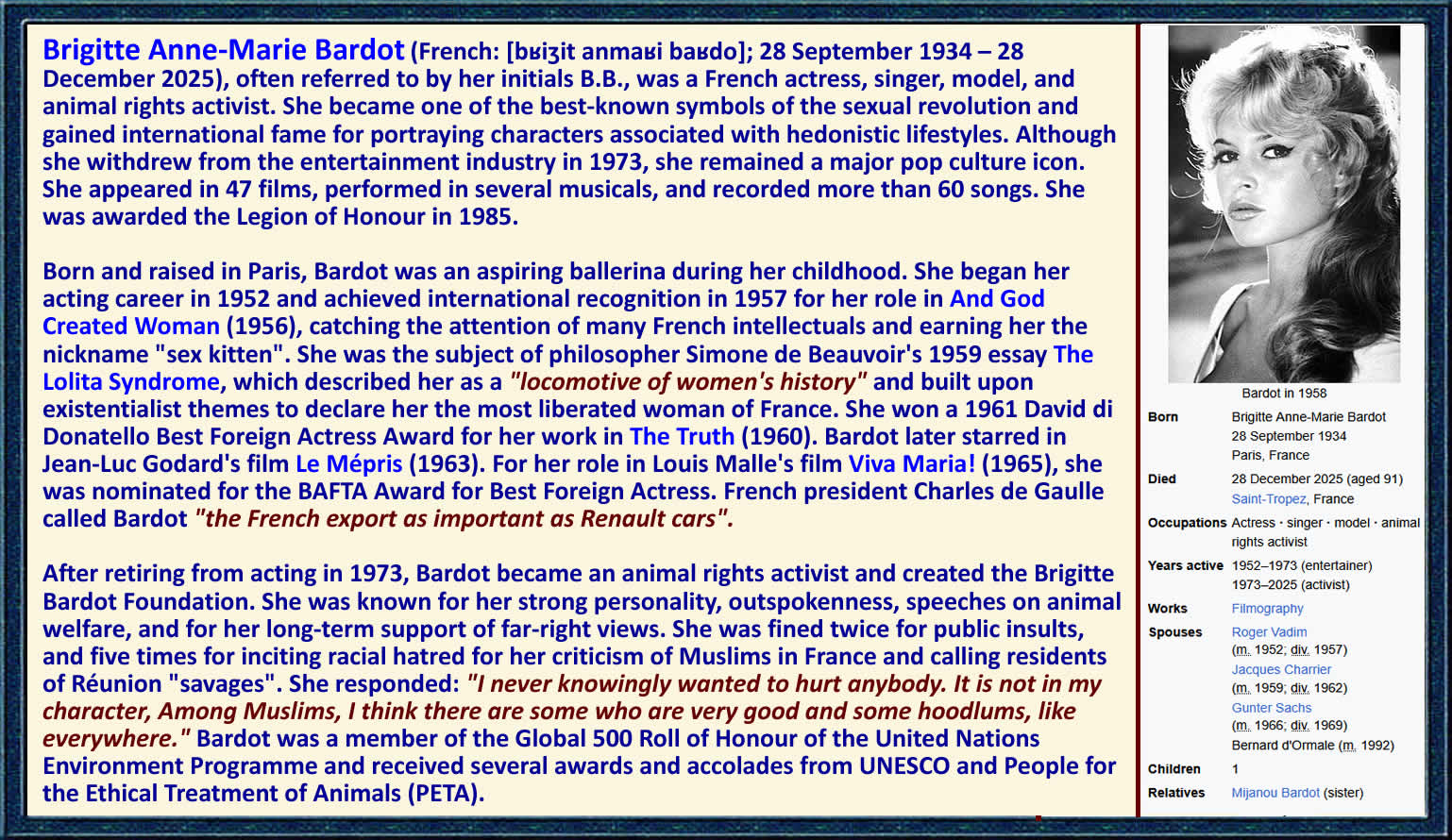
At the peak of her fame, one of the most photographed women on Earth simply stopped. She walked away
from cinema entirely and spent the second half of her life becoming someone almost nobody expected. Brigitte Bardot was born in Paris in 1934, and by her early twenties, she had become an international sensation, largely on the strength of one film. "And God Created Woman," released in 1956, made her a global symbol of a new, unapologetic kind of femininity one that felt dangerous and modern to audiences accustomed to something far more restrained. Over the next decade and a half, she starred in nearly fifty films and became one of the most recognized faces in the world. That fame came at a steep personal cost. Constant scrutiny, an almost total loss of privacy, and the relentless pressure of being reduced to an image rather than a person all took their toll. In 1973, at 39 years old and still at the height of her career, Bardot retired from acting entirely. Few major stars in history had ever walked away so completely, so early, or so permanently. But she didn't disappear into quiet retirement. In 1986, she founded the Brigitte Bardot Foundation, dedicating herself to animal welfare causes with the same intensity she had once brought to her film career. She campaigned against the clubbing of baby seals, the ivory trade, and conditions inside horse slaughterhouses, becoming one of the most visible animal rights activists in the world. That part of her legacy is genuinely significant, and it is widely respected even by people who came to disagree sharply with her on almost everything else. Because starting in the late 1990s, Bardot's public life took a turn that would come to define her almost as much as her film career had. She began making increasingly inflammatory public statements about Islam, immigration, and France's changing demographics, writing that the country was being "invaded" by what she called an overpopulation of foreigners, particularly Muslims. Between 1997 and 2008, French courts convicted her five separate times for inciting racial or religious hatred, fining her a total of tens of thousands of euros for repeated public statements targeting Muslim communities. In one case, a Paris court found she had characterized Muslims as barbaric invaders responsible for terrorism. In another, in 2019, she was prosecuted again after describing residents of the French island of Réunion as savages and degenerates. She also made dismissive public remarks about the #MeToo movement in 2018, and became an outspoken political supporter of far-right leader Marine Le Pen during Le Pen's 2012 and 2017 presidential campaigns, once calling her a modern Joan of Arc. Bardot never publicly retracted these positions or expressed regret for the convictions, maintaining in her own later writing that she had never intended to incite hatred, even as she continued making similar statements for decades. Her legacy therefore remains deeply divided. She reshaped how women could be portrayed on screen and helped build meaningful protections for animals worldwide. At the same time, she spent decades as one of France's most consistently convicted voices for hate speech, lending her enormous cultural platform to a political movement built substantially around excluding the very immigrants and religious minorities she frequently targeted. Both of these truths are part of the historical record, and neither one erases the other. |
 |
 |
 |
|
 |