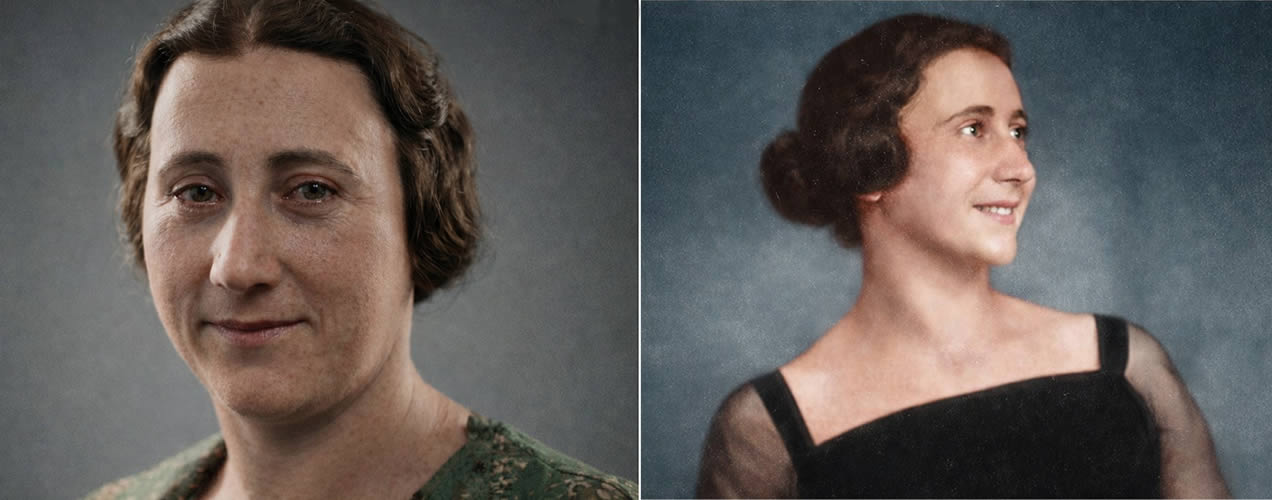
She died twenty-one days before liberation, never knowing that both of her daughters were already gone. The world knows Anne Frank’s diary. Millions recognize the attic, the bookcase, the hopeful voice that refused to be extinguished. But the woman who gave Anne life, who carried her through fear and hunger, and spent her final strength trying to keep her children alive, remains mostly unseen. Her name was Edith Holländer Frank.
Edith was born on January 16, 1900, in Aachen, Germany, to a prosperous Jewish family. Her childhood was filled with music, literature, and a sense of safety. She was thoughtful, reserved, and deeply attached to family. In 1925, she married Otto Frank, a businessman with quiet confidence. Together they built a comfortable life in Frankfurt.
Their first daughter, Margot, was born in 1926. Anne followed three years later. The family lived in a warm apartment filled with books and ordinary happiness. Edith devoted herself to her children, creating a home filled with love and routines. There was no reason to believe it could all vanish.
Then came 1933.
Hitler rose to power, and with him came laws that trapped Jewish families. Otto saw the danger early and moved to Amsterdam to start a business, hoping it would offer protection. Edith followed with the girls, leaving behind her home, language, and family.
Starting over wasn’t easy. Edith struggled with isolation but worked to create stability for her daughters. The girls learned Dutch and adapted to school, while Edith learned to manage a new life in a foreign country. She tried to convince herself that the worst had passed.
But it had not.
In May 1940, Nazi forces invaded the Netherlands. Jewish families faced exclusion from public life. Parks, cinemas, schools—everything was forbidden. Fear became constant.
On July 5, 1942, a letter arrived ordering Margot to report for labor service in Germany. Everyone knew what that meant: deportation.
Otto had prepared. Hidden rooms were created in his office building on Prinsengracht, and the family disappeared into the Secret Annex on July 6, 1942.
For Edith, the Annex offered a precarious safety. Eight people lived in a cramped space where silence was mandatory. Every sound could mean discovery. Meals were small, and time blurred into an endless cycle of fear.
Edith carried the weight of that fear differently than her daughters. She worried constantly and missed her family trapped in Germany. She tried to stay strong, but despair often crept in. Anne, young and rebellious, often clashed with her mother, frustrations recorded in her diary.
They remained hidden for more than two years.
On August 4, 1944, the Gestapo stormed the Annex. The family was arrested and sent to Westerbork, then on to Auschwitz.
There, Edith was separated from Margot and Anne. She spent her last days trying to keep them alive, even as her own strength failed. She gave her food to them and encouraged them through the despair. But in late October 1944, Margot and Anne were sent to Bergen-Belsen.
Edith watched them disappear. Her grief overtook her, and she stopped eating. By January 6, 1945, Edith Frank died in Auschwitz. She was forty-four.
Twenty-one days later, Soviet soldiers liberated the camp. Margot and Anne had died before that, and Otto Frank was the only survivor from the Annex. Miep Gies gave Otto the diary. Through Anne’s words, he discovered the daughter he had lost. The diary went on to change the world, but behind every page stood Edith: a woman who fled twice to protect her children; a mother who endured hunger and fear, giving everything she had to her daughters. Edith Frank is not a footnote: she is the unseen backbone of a story the world knows - a reminder that survival is built on sacrifice.