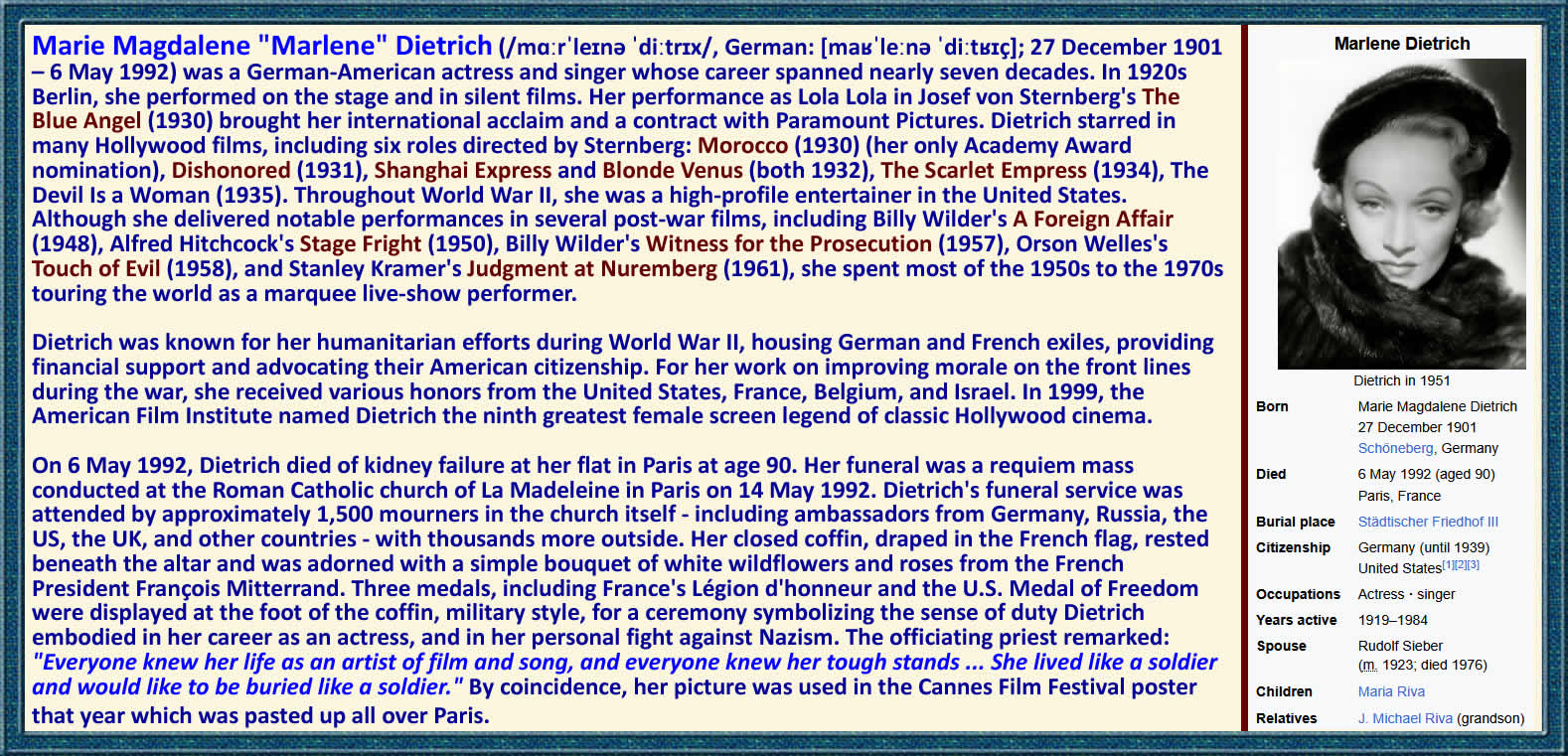
 |
 |
 |

Marlene Dietrich: The Berlin-born actress was one of the most famous women in the world. Her performance as the sultry cabaret singer in The Blue Angel had made her an international sensation. Adolf Hitler himself was reportedly a fan. The regime wanted her back - to star in propaganda films, to become the glamorous face of the Third Reich. Dietrich's answer was "NO." "Hitler is an idiot," she later said in a wartime broadcast beamed directly into Germany. "Boys, don't sacrifice yourselves. The war is crap." Her refusal came at a cost. The Nazis banned her films. They declared her a traitor. Her name became synonymous with betrayal in her homeland. But Dietrich had already made her choice. In 1939, she became an American citizen and renounced her German citizenship entirely. Then Pearl Harbor happened. And Marlene Dietrich decided she had more to give. From January 1942 to September 1943, she toured the United States selling war bonds - more than any other Hollywood celebrity, reportedly raising over one million dollars. But she wasn't content to stay safe in America. In 1944, she joined the USO and went to war. She began in North Africa, moved to Italy, performed in the UK, and eventually made her way to France - and then into Germany itself. She traveled with General George Patton. She walked with the troops into her former homeland. When asked why she took such risks - why she performed within kilometers of enemy lines - she gave a two-word answer in German: "Aus Anstand." Out of decency. Her grandson Peter Riva later recalled what fellow performer Danny Thomas used to say: "Your grandmother always wanted to get us killed. If there was any daylight left, we went to entertain guys on the front line. Sometimes we did the whole performance just for 10 guys!"
She understood the stakes. The Nazis had reportedly placed a bounty on her head. Joseph Goebbels had declared her an enemy of the Third Reich. And during the Battle of the Bulge, German counterattacks struck within a kilometer of her camp.
But she stayed. Dietrich suffered too: over the course of the war, she battled frostbite, influenza, and near-pneumonia. She slept in tents. She performed without power. She washed her hair in melted snow. She rolled up her sequined gowns in her knapsack and used them as pillows.
When one soldier, Lieutenant Russ Weiskircher, later recalled her visit to a Red Cross hospital in Naples where 3,000 wounded men were crammed into a 1,000-bed facility, he remembered her performing in a shimmering blue gown, singing songs, performing magic tricks she'd learned from Orson Welles, and telling raunchy jokes that left wounded men laughing.
She returned every day for a week.
Her act wasn't just glamour. She played the musical saw - a skill she'd learned in Berlin in the 1920s. She did a "mind-reading" routine. She performed for anyone who needed her: ten soldiers in a makeshift camp, three thousand in a hospital, whoever was there. But Dietrich's war work extended beyond the stage. In 1943, the Office of Strategic Services - the precursor to the CIA - approached her to participate in a secret propaganda project. She recorded American songs in German, including "Lili Marlene", which became beloved by soldiers on both sides of the conflict. The Nazi leadership tried to ban her music, but German soldiers on the front petitioned to have it reinstated. A U.S. Strategic Bombing Survey later concluded that her broadcasts were "just as devastating to German morale as an air raid." Behind the scenes, she did even more. In the late 1930s, before the war even began, she had created a fund with filmmaker Billy Wilder to help Jews escape Nazi Germany. She donated her entire salary from the 1937 film Knight Without Armour - $450,000 - to help refugees. She housed German and French exiles in her own home, provided them financial support, and advocated for their American citizenship. She was, in every sense, a woman at war. And remarkably, the woman whose voice drifted across enemy lines, whose presence on the front inspired troops and infuriated Nazis, had once contemplated something even more dangerous. According to biographer Charlotte Chandler and actor Douglas Fairbanks Jr., who was Dietrich's boyfriend in the late 1930s, she once discussed the possibility of assassinating Hitler herself. She knew he admired her. She believed she could arrange a private meeting. Fairbanks recalled her saying: "I would not expect to escape. I would go there prepared to die. I don't want to die. I want to live. Life is wonderful. But to kill Hitler would be wonderful." |
 |
 |
 |
 |
|
 |