 |
 |
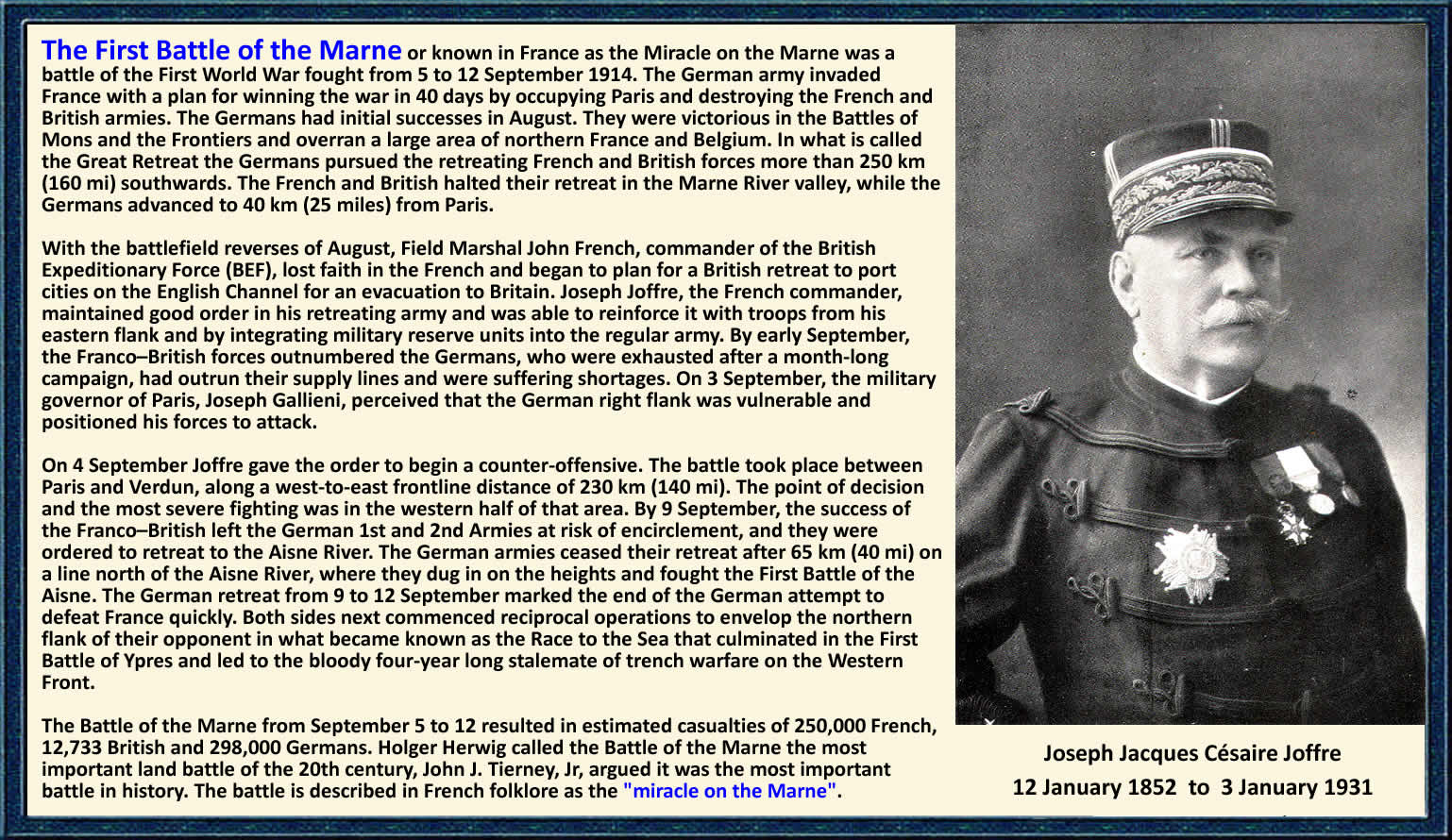
After sweeping through neutral Belgium, the German army had penetrated deep into France and was closing in on Paris. In the face of the relentless assault, the French army and its British allies had been unable to secure a line from which to stop the invaders and had been driven back 150 miles in what has gone down in history as “the Great Retreat.” Paris seemed doomed. On September 2, 1914, the French government had fled to Bordeaux and the masterpieces in the Louvre were hurriedly removed to the south. That evening a German plane dropped leaflets over the city. “There is nothing you can do but surrender,” the leaflets said. Joseph Gallieni, the Military Governor of Paris, was desperately trying to prepare defenses around the city, while begging for reinforcements and pleading with the British to come up and assist in the defense. Then, on September 3, Gallieni received some startling intelligence. Aerial reconnaissance indicated that the advancing German army had suddenly swung to the southeast, in hopes of enveloping the retreating French forces. Recognizing that the change in direction exposed the German flank, Gallieni convinced his commanding officer Joseph Joffre that the time had come to attack. Joffre agreed, abandoned his defensive plans, and began frantically pleading with the British commander to join the assault. At first the British command demurred, insisting that their army was not yet ready for combat. Joffre would not be so easily deterred. Pounding his fist on the table, he exclaimed, “Sir, the honor of England is at stake!” Finally, the British agreed to join in the attack. On September 5, having assembled his forces, Joffre issued a proclamation to his army. “The battle upon which hangs the fate of France is about to begin,” it read. “The time for looking back is past.” It would forever after be remembered as “the Miracle on the Marne.” After retreating for a month, a million French troops (including thousands who were ferried to the front by Paris taxis) and their 70,000 British allies turned suddenly and launched a massive counterattack, knocking back the previously unstoppable German army and turning the tide of the war. Paris was saved. Afterwards the German commander Alexander Von Kluck wrote: “That men will let themselves be killed where they stand is a well-known thing and counted on in every plan of battle. But that men who have retreated for ten days, sleeping on the ground and half dead with fatigue, should be able to take up their rifles and attack when the bugle sounds, is a thing upon which we never counted. It was a possibility not studied in our war academy.” The French philosopher Henri Bergson offered a simple, albeit mystical, explanation. “Joan of Arc won the Battle of the Marne,” he said. The German army was driven back 40 miles. France had been saved, but at a brutal cost. After six days of savage fighting, the French and German armies had each lost over 250,000 men and the British had lost over 13,000, a horrifying taste of much worse to come. For the next month the armies extended their flanks, until they were facing each other in an unbroken line of trenches that stretched from the English Channel to the border of Switzerland, from which the war would continue for another four years. |